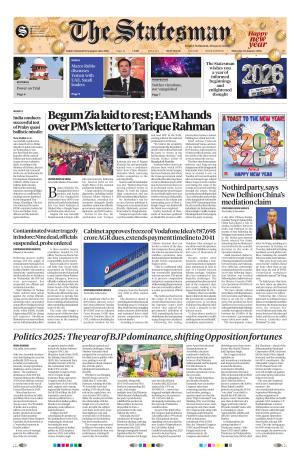
India’s National Newspaper since 1818 | Pages 12 | ` 5.00 | KOLKATA | NEW DELHI | SILIGURI | BHUBANESWAR | Thursday, 01 January 2026 WORLD Marco Rubio discusses Yemen with UAE, Saudi leaders EDITORIAL Power on Trial India conducts successful test of Pralay quasi ballistic missile: New Delhi: India successfully conducted a salvo launch of two Pralay missiles in quick succession on Wednesday. It was test-fired from the same launcher off the coast of Odisha and was conducted as part of user evaluation trials. According to the Ministry of Defence, the test was carried out at around 10:30 a.m. on Wednesday by the Defence Research & Development Organisation (DRDO), off the coast of Odisha. Both missiles followed the intended trajectory, meeting all flight objectives as confirmed by tracking sensors deployed by the Integrated Test Range, Chandipur. The test was witnessed by senior DRDO scientists, Indian Air Force and Indian Army officers and the industry representatives. Bhopal, 31 December Following massive public outrage over the supply of contaminated Narmada river water to households in a locality of Indore ~ the country’s cleanest city ~ and the reported ninth death due to diarrhoea on Wednesday, the BJP-led state government has suspended two officials and terminated another. Chief Minister Dr Mohan Yadav ordered strict action against the erring officials. Acting on his directions, the administration suspended zonal officer Shaligram Sitole and assistant engineer Yogesh Joshi, while Public Health Engineering (PHE) in-charge sub - engineer Shubham Shrivastava was removed from service with immediate effect. Page 7 Begum Zia laid to rest; EAM hands over PM’s letter to Tarique Rahman UNITED NEWS OF INDIA New Delhi/Dhaka, 31 December B egum Khaleda Zia, Bangladesh’s former premier and leader of the Bangladesh Nationalist Party (BNP), was laid to rest beside her husband, late Gen Ziaur Rahman at Dhaka’s Sher-e-Bangla Nagar on Wednesday afternoon. Begum Zia was formally buried around 4.30 p.m. with Contaminated water tragedy in Indore: Nine dead, officials suspended, probe ordered STATESMAN NEWS SERVICE Neither victorious, nor vanquished Page 9 Page 6 BRIEFLY PERSPECTIVE A three-member inquiry committee, headed by IAS officer Navjeevan Pawar, has also been constituted to fix responsibility in the matter. Sources said a five-monthold baby boy, Avyan Sahu, succumbed on Wednesday, taking the reported death toll to nine. Indore Mayor Pushyamitra Bhargava, however, officially confirmed only seven deaths so far. Meanwhile, the Indore bench of the Madhya Pradesh High Court on Wednesday directed the state government to provide free treatment to people suffering from vomiting and diarrhoea after consuming contaminated water in the city. The court also sought a status report within two days on the contaminated drinking water issue in the country’s cleanest city. full state honours, following her funeral held at the South Plaza of the national parliament building. A large number of foreign dignitaries, including India’s External Affairs Minister S Jaishankar, attended the ceremony alongside family members, senior state officials, government representatives, diplomats, and BNP leaders. Earlier in the day, Mr Jaishankar met Tarique Rahman, the son of Begum Khaleda Zia, and personally handed over a condolence letter from Prime Minister Narendra Modi, conveying India’s sympathies to the grieving family. Sources said Mr Jaishankar was also “briefed about fast moving political events in Dhaka” by both the Indian High commission and top BNP and other political leaders. Mr Jaishankar’s trip for an out of power politician is being seen as an unusual and friendly diplomatic gesture from India by Bangladeshis. Tarique is expected to take over the mantle of his mother and lead BNP in the forthcoming polls for the national parliament in February. “We believe the sympathy wave generated by his mother’s death could well lead him and his party to victory in the forthcoming elections,” said Nizam, former editor of Bangladesh Pratidin. Analysts believe that in an election from which BNP’s main rival, the Awami League, has been banned, and where the Yunus government stand discredited for allowing chaos to rule on Dhaka’s streets, BNP may be have its best shot ever at an electoral vctory. Access to the burial site where Begum Zia was finally laid to rest, was strictly restricted, while public movement in Zia Udyan and surrounding areas of Sher-eBangla Nagar was limited till the burial was completed. Earlier, hundreds of thousands of mourners gathered at Manik Mia Avenue to offer prayers at her ‘namaz-e-janaza’, bidding her a final farewell. Chief Adviser Professor Muhammad Yunus, advisers of the interim government, BNP leaders, representatives of other political parties, and the chiefs of the three armed services joined the service. The three-time former prime minister and long-serving chairperson of the Bangladesh Nationalist Party had passed away at around 6 a.m. on Tuesday at Evercare Hospital after a prolonged, age-related illness.Large crowds could be seen lining the route of the cortege as it passed solemnly through the streets. People had started assembling around 7 a.m, with leaders and activists of the Bangladesh Nationalist Party (BNP) streaming in from the city as well as from districts including Feni, Brahmanbaria, Mymensingh, Comilla, Gazipur, Munshiganj and Narayanganj, where the party is strong. Cabinet approves freeze of Vodafone Idea’s `87,695 crore AGR dues, extends payment timeline to 2041 STATESMAN NEWS SERVICE New Delhi, 31 December In a significant relief to the debt-laden telecom sector, the Union Cabinet on Tuesday approved a proposal to freeze Rs 87,695 crore in Adjusted Gross Revenue (AGR) dues owed by Vodafone Idea Ltd (VIL), while rescheduling the payment window for the company from the financial year 2032 to 2041, sources said. The decision is aimed at providing immediate financial breathing space to Vodafone Idea, which has been struggling under a massive debt burden and sustained losses amid intense competition in the telecom market. According to sources, the Cabinet decision does not involve a waiver of the dues but a temporary freeze, giving the telecom operator time to stabilise operations, raise funds and improve its financial health before repayments begin in 2032. “This is a calibrated relief measure to support a stressed but systemically important telecom operator. The intent is to preserve competition and protect consumer interest while ensuring that government dues are eventually realised,” a senior government official said. The AGR issue has been at the centre of the telecom sector’s financial stress since the Supreme Court’s 2019 verdict that upheld the government’s definition of AGR, expanding the base on which licence fees and spectrum usage charges are calculated. Following the ruling, Vodafone Idea emerged as one of the worst-hit operators, with AGR liabilities running into tens of thousands of crores. Despite earlier relief measures, including a fouryear moratorium on statutory dues announced in 2021 as part of a broader telecom reforms package, Vodafone Idea has continued to face liquidity challenges. The government has also converted part of the company’s dues into equity, making it the largest shareholder in VIL. Industry observers said the latest Cabinet decision signals the government’s continued commitment to keeping Vodafone Idea afloat in order to avoid a duopoly in the telecom sector. “A three-player market is crucial for competitive tariffs and long-term sectoral health,” an industry expert noted. No third party, says New Delhi on China’s mediation claim STATESMAN NEWS SERVICE New Delhi, 31 December A day after Chinese foreign minister Wang Yi claimed that China had played a role in ending hostilities between India and Pakistan in the month of May following the Pahalgam terror attack, sources in the Indian government firmly rejected the claim, reiterating that no third party was involved in the ceasefire decision in the wake of Operation Sindoor. Amid repeated claims by US President Donald Trump of having mediated to ceasefire between India and Pakistan, New Delhi has consistently maintained that the ceasefire on 10 May following Operation Sindoor, was reached following direct talks between the Director General of Military Operations (DGMOs) of the two countries. “We have already refuted such claims. On bilateral issues between India and Pakistan, there is no role for a third party. Our position has been clarified on several occasions in the past that the India-Pakistan ceasefire was agreed to directly between the DGMOs of the two countries,” a government source told a news outlet. The development comes after Mr Wang, speaking at a symposium in Beijing on Tuesday, claimed that Beijing mediated several global conflicts, including the standoff between India and Pakistan. “This year, local wars and cross-border conflicts flared up more often than at any time since the end of WWII. Geopolitical turbulence continued to spread,” Mr Wang said. “To build peace that lasts, we have taken an objective and just stance, and focused on addressing both symptoms and root causes,” he added. “Following this Chinese approach to settling hotspot issues, we mediated in northern Myanmar, the Iranian nuclear issue, the tensions between Pakistan and India, the issues between Palestine and Israel, and the recent conflict between Cambodia and Thailand,” he said. Politics 2025 : The year of BJP dominance, shifting Opposition fortunes VIBHA SHARMA New Delhi, 31 December Only two Assembly elections were held during the year, but politically 2025 was an eventful year marked by intensity, strong Opposition challenges, and a common theme ~ the continued dominance of the BJP-led National Democratic Alliance (NDA) that, midway, seemed to set the tone of the rest of India’s electoral cycle till the General Elections in 2029. Other than the two Assembly elections in Delhi and Bihar, there was a rather unexpected election to choose a new Vice President of India, and a surprise saffron win in the local bodies’ elections in Kerala’s capital Thiruvananthapuram, which Prime Minister Narendra Modi described as a “watershed moment in Kerala’s politics”. It was a year of strategic gains for the saffron side ~ one of the six currently recognised parties which include the Indian National Congress (INC), the Bharatiya Janata Party (BJP), the Bahujan Samaj Party (BSP), the Communist Party of India (Marxist) (CPI-M), the Communist Party of India (CPI), and the Nationalist Congress Party (NCP). Despite tough resistance from opponents ~ Congress and the Aam Aadmi Party (AAP) in Delhi, and Congress and a strong regional ally Rashtriya Janata Dal (RJD) in Bihar, the BJP remained a much more cohesive political force, a behemoth in Indian politics, thanks to its strategic planning, scale, influence, and dominance. In Bihar, the BJP consolidated its position as the leading force in the NDA, weakening its rivals and becoming the most successful party in Indian politics in 2025, despite a narrower 2024 Lok Sabha victory. Despite tough geopolitical, regional and domestic challenges, Prime Minister Narendra Modi navigated the second year of his third term in politics with ease, putting to rest all speculations about strained ties with the party’s ideological fountainhead ~ the RSS. Whether it was bringing the BJP back to power in Delhi after 27 years this February, winning 48 of the 70 Assembly seats and ending AAP’s decade-long rule in the capital state, or a very decisive NDA sail in Bihar, the results proved that the relationship with the Sangh was very much on track. In Delhi, the saffron vote share went up by more than eight per cent, and several senior AAP leaders, including Arvind Kejriwal, lost their constituencies. The scenario was repeated in Bihar in November, where the BJP recorded its best-ever performance, winning 89 seats in the 243-member Assembly. Along with JD(U)’s 85 seats, the NDA landed a commanding 202 seats. And despite multiple-time Chief Minister Nitish Kumar's failing health, his party's performance solidified his position in Bihar politics, in that it is impossible to form a government in the state without the JD(U). Nationally, the BJP continued to leverage its Hindutva ideology, carrying forward its 2024 Lok Sabha momentum into 2025 through strategically-framed legislation like the Viksit Bharat Guarantee for Rozgar and Ajeevika Mission (Gramin) Bill, 2025, that replaced the UPA-era MGNREGA ~ a move that triggered multiple objections, including over its acronym ~ VB-G RAM G Bill, its ideological positioning, and the removal of Mahatma Gandhi’s name. As part of the INDIA bloc, the Congress had doubled its Lok Sabha tally to 99 seats in the 2024 general election, signalling a revival under the new Leader of Opposition in the Lok Sabha, Rahul Gandhi’s leadership, but 2025 proved to be less than a mixed bag for the grand old party. Apart from electoral disappointments in Assemblies, the party continued to battle the mid-term leadership crisis between Chief Minister Siddaramaiah and his deputy D K Shivakumar in Karnataka. The situation remains unresolved even as the year ends. After Punjab, Rajasthan, and Madhya Pradesh, Karnataka was yet another Congress-ruled state witnessing mayhem amid local rivalries, putting a question mark on what the party “High Command” was thinking. Why was it letting the issue fester in a key state, among the only three under the Congress rule, along with Telangana and Himachal Pradesh? Facing strained ties with an important constituent of the INDIA bloc, the Trinamul Congress (TMC) in poll-bound West Bengal, much to its embarrassment, the Congress also battled dissenting notes from senior leaders like Shashi Tharoor and Digvijaya Singh. The Congress tried to capitalise on anti-incumbency sentiments and sharpened its narrative around the Election Commission of India’s Special Intensive Revision (SIR) of electoral rolls in 2025, but its allegations of “vote chori” failed to deliver a decisive counter to the BJP in Bihar. Rahul Gandhi’s protests, accusing the ECI of “vote chori” (vote theft) to benefit the BJP, failed to impress voters. Meanwhile, now there is this buzz of a bigger and better role for Priyanka Gandhi Vadra, who is emerging as a more “approachable, affable, and effective” person than her brother. In Maharashtra, the coming together of Thackeray cousins ~ Shiv Sena (UBT) chief Uddhav Thackeray and Maharashtra Navnirman Sena (MNS) chief Raj Thackeray ~ ahead of the Brihanmumbai Municipal Corporation (BMC) elections left the Maha Vikas Aghadi fractured, and the remaining two MVA constituents ~ the Nationalist Congress Party (NCP) Sharad Pawar (SP) faction and the Congress ~ were left to fight out against each other in the polls to the richest civic body. The year also surprised with a rare Constitutional moment ~ the vice-presidential election in September following the sudden resignation of Jagdeep Dhankhar on health grounds. NDA nominee C P Radhakrishnan, a former Maharashtra Governor and RSS veteran, sailed through with 452 first-preference votes against Opposition candidate Justice B Sudershan Reddy, who got 300 votes. The only saving grace for BJP's rivals waa the 152vote margin, the narrowest in a vice-presidential election since 2002.
The Statesman is one of India's oldest English newspapers. It was founded in Kolkata in 1875 and is directly descended from The Friend of India (founded 1818). The Englishman (founded 1821) was merged with The Statesman in 1934. The Delhi edition of The Statesman began publication in 1931. The Statesman Weekly is a compendium of news and views from the Kolkata and Delhi editions. Printed on airmail paper, it is popular with readers outside India. The Statesman (average weekday circulation approximately 180,000) is a leading English newspaper in West Bengal. The Sunday Statesman has a circulation of 230,000.