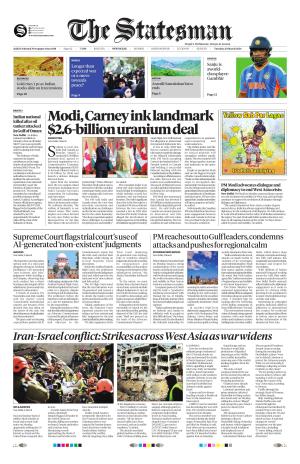
FOLLOW US: @TheStatesmanLtd @thestatesmanltd thestatesman1875 www.thestatesman.com People’s Parliament, Always in Session India’s National Newspaper since 1818 | Pages 12 | ` 5.00 | KOLKATA | NEW DELHI | MUMBAI | BHUBANESWAR | LUCKNOW | Gold rises 1 pc as Indian stocks slide on Iran tensions Page 10 BRIEFLY Indian national killed after oil tanker attacked in Gulf of Oman: New Delhi: An Indian national was killed on Monday when an oil tanker MKD Vyom was reportedly targetted in the Gulf of Oman amid escalating Iran-Israel tensions. "The Embassy of India expresses its deepest condolences on the tragic demise of an Indian national on board MKD Vyom. The Embassy is in close coordination with the local authorities in Oman to facilitate the safe and early repatriation of our nationals on board the vessel," the Embassy of India in Oman posted on X. "We remain committed to extending all possible assistance in this matter," it added. According to Oman's official news agency, the oil tanker MKD VYOM, flagged to the Republic of the Marshall Islands, was attacked by an USV approximately 52 nautical miles off the coast of the Sultanate of Oman. | Tuesday, 03 March 2026 SPORTS WORLD BUSINESS SILIGURI Longer than expected war or a move towards peace? Sanju is aworldclassplayer: Gambhir NATION Aravalli SanrakshanYatra ends Page 5 Page 9 Page 12 Modi, Carney ink landmark $2.6-billion uranium deal ASHOK TUTEJA New Delhi, 2 March S eeking to reset ties, India and Canada on Monday signed a landmark $ 2.6 billion uranium deal, agreed to fast-track negotiations on a Comprehensive Economic Partnership Agreement (CEPA) to increase bilateral trade to $ 50 billion by 2030 and launch a defence dialogue between them. Apart from the uranium deal, the two nations inked seven pacts, including one on India- C anada-Australia cooperation for technology and innovation. ‘’India and Canada strongly believe in democratic values. We celebrate diversity. The welfare of humanity is our shared vision. This vision inspires us to move forward in every area. Today, we also discussed how we can take this vision to the next level of partnership,’’ Prime Minister Narendra Modi said at a press interaction with his Canadian counterpart Mark Carney after wide-ranging talks between the two leaders. The PM said India and Canada share the view that terrorism, extremism and radicalisation are challenges not for the two countries alone but for the entire humanity. ‘’Our deep cooperation against these challenges is essential for global peace and stability,’’ he added. The Canadian leader is on a four-day visit to India at the head of a high-level delegation, which includes several key ministers and top business honchos. The visit is significant since this is the first trip by a Canadian PM since relations between the two countries touched a low in 2023 after the then PM Justin Trudeau alleged the involvement of Indian agencies in the killing of Khalistan supporter Hardeep Singh Nijjar. New Delhi termed the allegation as absurd and downgraded diplomatic ties. It was in June 2025 that the two countries decided to take steps to repair the damage to the bilateral relationship with PM Modi accepting Carney’s invitation for the G-7 Summit hosted in Canada and holding a successful bilateral meeting with the Canadian leader on the sidelines. According to official sources, the talks between the two leaders were cordial and they discussed all bilateral issues as well as global developments, including the developments in West Asia. PM Modi also announced that Canada has invested $ 100 billion in India’s pension fund, reflecting India’s growth story. He said India and Canada are natural partners in innovation and this partnership will turn ideas into global solutions. The two countries, he said, will increase cooperation in AI, quantum, supercomputing and semiconductors. The Indian leader said the MOU between the two countries on critical minerals will strengthen resilient supply chains. The two countries will also bring together startups and industries in the space sector. People-to-people ties, Modi said, are the biggest strength of India-Canada relationship. ‘’Today we have taken important steps to strengthen this partnership.’’Announcements are also being made today for partnerships between universities for cooperation in AI, healthcare and innovation. We have also agreed that Canadian universities will open campuses in India,’’ he added. In his remarks, the Canadian PM noted that there have been more engagements between India and Canada in the last one year than in the previous two decades combined. PM Modi advocates dialogue and diplomacy to end West Asia crisis: New Delhi: PM Modi on Monday expressed deep concern over the escalation in hostilities in West Asia and said India continues to support the resolution of all disputes through dialogue and diplomacy. “The current situation in West Asia is a matter of grave concern for us. India has always supported dialogue and diplomacy for the settlement of all disputes. We will continue to work with all nations for the safety of all Indian nationals in the region,’’ he said. Modi said India’s position has been very clear on all ongoing tensions in the world. “we have always called for peace and stability,’’ he added. Supreme Court flags trial court’s use of AI-generated ‘non-existent’ judgments PM reaches out to Gulf leaders, condemns attacks and pushes for regional calm AGENCIES STATESMAN NEWS SERVICE New Delhi, 2 March The Supreme Court has taken serious note of a trial court allegedly relying on Artificial Intelligence (AI)-generated "non- existent and fake" judgments while deciding a civil dispute, observing that such conduct has a direct bearing on the integrity of the adjudicatory process and may amount to misconduct. A bench of Justices P.S. Narasimha and Alok Aradhe said the matter raised "considerable institutional concern, not because of the decision that was taken on the merits of the case, but about the process of adjudication and determination". The apex court was hearing a special leave petition (SLP) challenging a judgment of the Andhra Pradesh High Court, which had upheld a trial court order in a property dispute involving a suit for injunction. The petitioners before the Supreme Court are defendants in a suit for injunction filed by the respondents. During the pendency of the suit, the trial court had appointed an Advocate Commissioner to record the physical features of the property. The petitioners had objected to the Commissioner’s report, but the trial court rejected their objections while relying on several Supreme Court precedents. Before the Andhra Pradesh High Court, the petitioners contended that the judgments cited and relied upon by the trial court were "non-existent and fake orders". The AP High Court noted that the cited decisions were AI-generated and issued a word of caution, but proceeded to decide the matter on the merits and dismissed the civil revision petition. Taking cognisance of the issue, the Supreme Court expressed concern over the reliance on "non-existent and fake" judgments by the trial court in judicial decision-making. "We take cognisance of the Trial Court deploying AI-generated non-existing, fake or synthetic alleged judgments and seek to examine its consequences and accountability as it has a direct bearing on the integrity of the adjudicatory process," the Justice Narasimha-led Bench said. "At the outset, we must declare that a decision based on such non-existent and fake alleged judgments is not an error in the decision-making. It would be a misconduct, and legal consequence shall follow," the apex court added. Issuing notice in the matter, returnable on March 10, the top court directed that, pending disposal of the SLP, the trial court "shall not proceed on the basis of the Advocate Commissioner’s Report". New Delhi, 2 March Prime Minister Narendra Modi on Monday issued a strong condemnation of the recent attacks on Bahrain and Saudi Arabia, voicing India’s solidarity with both nations and urging the swift restoration of peace and stability in West Asia as tensions continue to escalate. In separate posts on X, Modi said he held a “productive telephone conversation” with Hamad bin Isa Al Khalifa, King of Bahrain, during which he conveyed India’s unequivocal support. “India condemns the attacks on Bahrain and stands in solidarity with its people in this difficult hour,” the Prime Minister said. He also thanked the Bahraini leadership for ensuring the safety and welfare of the large Indian community residing in the Gulf country. “I thank him for the steadfast support extended to the Indian community in Bahrain,” Modi added. In another high-level diplomatic engagement, Modi spoke with Mohammed bin Salman, Crown Prince and Prime Minister of Saudi Arabia, to discuss the rapidly evolving security situation in West Asia. “India condemns the recent attacks on Saudi Arabia in violation of its sovereignty and territorial integrity,” Modi said, underscoring New Delhi’s firm stance against actions that undermine regional stability. He noted that both leaders agreed the “earliest restoration of regional peace and stability is of utmost importance.” The Prime Minister also expressed appreciation for Saudi Arabia’s efforts to safeguard the Indian diaspora amid the crisis. “I thanked him for looking after the well-being of the Indian community in these difficult times,” he said. The conversations come at a time of sharply rising regional tensions, with cross-border strikes and retaliatory actions fuelling fears of a wider conflict. India, which shares deep strategic, economic and energy ties with Gulf nations, has consistently advocated restraint, dialogue and respect for sovereignty. With millions of Indian nationals living and working across the Gulf, their safety remains a central concern for New Delhi. Modi’s outreach reflects India’s active diplomatic engagement as it seeks to protect its citizens while pressing for de-escalation in a region vital to global energy security and trade. Reiterating its principled position, India has called for adherence to international law, respect for territorial integrity and immediate efforts to restore calm to prevent further deterioration of the situation in West Asia. Iran-Israel conflict: Strikes across West Asia as war widens SNS & AGENCIES New Delhi, 2 March Iran and Iranian-backed militias fired missiles at Israel and several Arab states on Monday, apparently striking the US Embassy compound in Kuwait, as Israel and the United States targeted sites in Iran. A bomb-laden drone boat struck a Marshall Islands-flagged oil tanker in the Gulf of Oman on Monday, killing one mariner on board, Omani authorities said. Iran has been threatening vessels approaching the Strait of Hormuz and is believed to have launched multiple attacks. Earlier, Saudi Aramco temporarily shut down its Ras Tanura oil refinery near Dammam after it was targeted by Iranian drones. Iran’s decision to strike the Saudi refinery further escalated the conflict, directly targeting a key pillar of the kingdom’s economy. The US military’s Central Command said the incident occurred during a combat mission as Iran attacked the country. “All six aircrew ejected safely, have been recovered, and are in stable condition,” it added. The attacks unsettled global markets on Monday, with US futures falling more than 1 per cent and oil prices surging, although gains for defence contractors and oil companies helped limit losses in Asian trading. European markets opened sharply lower. Germany’s DAX fell 2.2 per cent to 24,737.47, while France’s CAC 40 dropped 1.9 per cent to 8,413.91. Britain’s FTSE 100 declined 1 per cent to 10,800.63. Over the weekend, the militant group condemned the US-Israeli attacks on Iran and mourned the death of Iran’s Supreme Leader, Ayatollah Ali Khamenei, before signalling it might intervene. Early on Monday, it did so. Israel responded with strikes on the southern suburbs of Beirut. It was the first time in more than a year that Hezbollah has claimed a strike against Israel. Cyprus said two drones heading towards a British air base on the island were intercepted. A fifth US service member has died during the war with Iran, US Central Command announced on Monday. The service member was wounded during the initial stage of Operation Epic Fury and died on Monday, it said. Four other service members have been killed since Israel and the US launched strikes against Iran on Saturday. QatarEnergy said on Monday it would halt production of liquefied natural gas as the Middle East conflict intensifies, removing one of the world’s leading suppliers from the market. The state-owned company blamed the war for the decision but did not provide a timeline for resuming production. Oil prices have already risen amid the conflict. Lebanon’s president and prime minister criticised Hezbollah for firing rockets into Israel early on Monday, calling the actions “illegal” and saying they gave Israel a pretext to destroy the country. The announcement followed a five-hour Cabinet meeting to discuss Hezbollah’s firing of missiles and drones, which triggered a deadly Israeli retaliation and displaced tens of thousands of people. Information Minister Paul Morcos quoted President Joseph Aoun as saying during the meeting that Hezbollah’s actions “were not to defend Lebanon or protect the Lebanese people. What we are witnessing is buildings collapsing on their residents as they sleep”. “We are giving a pretext to Israel to destroy what is still standing. I wish we could change the course of the war,” Aoun said, according to Morcos. Traffic through the strategic Strait of Hormuz has fallen sharply. Ship-tracking platform MarineTraffic.com said transit through the chokepoint had declined by around 70 per cent since Saturday, when the US and Israel launched a major attack on Iran. It reported changes in vessels’ navigation over the past three days, including “U-turns, idling, reduced speeds, and last-minute diversions.”
The Statesman is one of India's oldest English newspapers. It was founded in Kolkata in 1875 and is directly descended from The Friend of India (founded 1818). The Englishman (founded 1821) was merged with The Statesman in 1934. The Delhi edition of The Statesman began publication in 1931. The Statesman Weekly is a compendium of news and views from the Kolkata and Delhi editions. Printed on airmail paper, it is popular with readers outside India. The Statesman (average weekday circulation approximately 180,000) is a leading English newspaper in West Bengal. The Sunday Statesman has a circulation of 230,000.