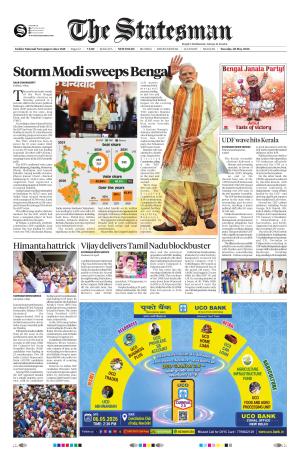
FOLLOW US: @TheStatesmanLtd @thestatesmanltd thestatesman1875 www.thestatesman.com People’s Parliament, Always in Session India’s National Newspaper since 1818 | Pages 12 | ` 5.00 | KOLKATA | NEW DELHI | MUMBAI | BHUBANESWAR | LUCKNOW | SILIGURI | Tuesday, 05 May 2026 Storm Modi sweeps Bengal RAJIB CHAKRABORTY Kolkata, 4 May T he results and early trends of the West Bengal Assembly elections on Monday p ointe d to a tectonic shift in the state’s political landscape, with the Bharatiya Janata Party (BJP) poised to form its first government in the state, long dominated by the Congress, the Left Front, and the Trinamul Congress (TMC). According to data released by the Election Commission of India (ECI), the BJP had won 176 seats and was leading in nearly 32 constituencies as counting progressed across 293 Assembly segments till 9.30 p.m. The TMC, which has been in power for 15 years under Chief Minister Mamata Banerjee, managed to secure 59 seats and was leading in around 20 others (till 9.30 p.m.), indicating a sharp reversal from its sweeping victory in the 2021 Assembly polls. The BJP’s confirmed wins came from Kalimpong, Darjeeling, Monteswar, Bhatar, Medinipur, and Asansol Dakshin. Among notable victories, Bharat Kumar Chetri clinched Kalimpong by 21,464 votes, while Angimitra Paul registere d a commanding margin of 40,839 votes in Asansol Dakshin. Sankar Kumar Guchhait triumphed in Medinipur by 38,747 votes, and Saikat Panja secured Monteswar with a margin of 14,798 votes. Karfa Soumen won Bhatar by 6,528 votes, and Noman Rai emerged victorious by 6,057 votes. The saffron surge marks a historic moment for the BJP, which had been a marginal player in West Bengal politics for decades. In Singur, a politically symbolic constituency, BJP candidate Arup Kumar Das was leading by 4,924 votes over TMC’s Becharam Manna. Earlier minister Snehasis Chakraborty was leading by 4,693 votes till 6.30 p.m. Several other ministers, including Sujit Bose, P ulak Roy, Sabina Yasmin, Srikanta Mahato, and Birbaha Hansda, were also reported to be behind their rivals. The tre nd s assume adde d significance as the TMC government had relied heavily on its welfare schemes and grassroots organisational strength, with many of these leaders serving as key faces of governance. The apparent setback suggests a broader shift in voter sentiment across b o th urban and r ural constituencies. Meanwhile, the Congress and the L eft par ties continued their marginal presence, leading in just two and one seats respectively, indicating their limited impact on the evolving electoral dynamics. To add insult to injury TMC supremo Mamata Banerjee was humbled in her bastion Bhawanipore by 15,105 votes by her b e t e n o i r e S u ve n d u Adhikari. A furious Mamata Banerjee attributed the shock Bengal results to "loot, loot, loot", underscoring that her party, the Trinamool, will bounce back. Banerjee, who was aiming for a fourth term, targeted the E l e c t i o n Commission, calling it the "BJP Commission" after results showed the BJP in the lead and her party a distant second. "More than 100 seats BJP looted. The E l e c t i o n Commission is the BJP's commission. I complained to the CO and also Manoj Agrawal, but they a re n o t d o i n g anything," B a n e r j e e , s u r ro u n d e d by security personnel, t o l d reporters. UDF wave hits Kerala STATESMAN NEWS SERVICE Thiruvananthapuram, 4April Himanta hattrick Vijay delivers Tamil Nadu blockbuster STATESMAN NEWS SERVICE Chennai, 04 April STATESMAN NEWS SERVICE Guwahati, 4 May In an awesome performance, the ruling BJP-led National Democratic Alliance (NDA) decimated the Congress-headed ASM to remain on course to record its third consecutive victory in the Assam Assembly polls on Monday. With trends/results available from all 126 seats in the northeastern state, the NDA has won or is in the lead in as many as 100 seats, while the Congress-led Asom Sonmilito Morcha (ASM) candidates were leading in 23 constituencies. Two All India United Democratic Front (AIUDF) candidates and one independent nominee were also maintaining leads over their opponents. Among NDA constituents, the BJP appeared headed for a simple majority on its own, with its candidates A political tsunami christened Vijay has dethroned the MK Stalin government in Tamil Nadu, leaving the ruling DMK unable to break the second consecutive term jinx, while in neighbouring Puducherry, the squabble over seat sharing in the Congress-DMK alliance till the eleventh hour, has enabled incumbent Chief Minister and AINRC having won in 13 constituencies, and leading in 69 more. Its alliance partner, the Bodoland People's Front (BPF) has picked up one seat, continues to lead in 9 more. The Asom Gana Parishad (AGP) candidates were ahead in 8 seats, respectively. In the ASM camp, Indian National Congress candidates were leading in 20 seats, the Raijor Dal was ahead in two constituencies, and All India Trinamool Congress in 1. In Jalukbari, Chief Minister Himanta Biswa Sarma's victory announcement seems only a matter of time, as he was leading over his nearest rival Bidisha Neog by more than 80,000 votes.with two more rounds of counting remaining. However, in Jorhat, BJP candidate Hitendra Nath Goswami emerged as a giant killer, by defeating state Congress chief Gaurav Gogoi by over 23,000 votes. president, N Rangasamy, to retain power. Despite heading a 25-party Maha Gathbandan, the DMK has been made to bite the dust and th e principal opposition AIADMK, heading the NDA, pushed to the third place, indicating its downward slide under Edappadi K Palaniswami (EPS). TVK has eaten into the vote share of both the AIADMK and the DMK. The vote share of the DMK had drastically come down from 38 percent in 2021 to 24.20 percent this time, while that of the AIADMK from 33.5 percent to 21.36 per cent. In the former French enclave, Puducherry Union Territory, Rangasamy trounced his nearest Congress rival V Vaithilingam, MP, touted as the Chief Ministerial face of the grand old party. The AINRC had bagged 12 seats while its allies BJP (4) and LJK (1), securing majority in a house of 30. While DMK had secured 5 seats the Congress could muster only one with independents winning 5 seats. The Kerala Assembly elections delivered a historic and sweeping mandate in favour of the United Democratic Front (UDF), bringing an end to the decade -long rule of the CPI(M)-led Left Democratic Front (LDF). The UDF crossed the majority mark decisively, winning over 100 seats in the 140-member Assembly. The UDF has thus reclaimed power in the state with a resounding and decisive victory, marking a major political shift after 10 years of Left rule. Public dissatisfaction over governance, financial management, and persistent corruption allegations had been building for years, eventually reaching a tipping point. This provided the UDF with a significant opportunity to position itself as a credible alternative. The alliance also successfully rebuilt its core social coalition, with Muslim and Christian minorities consolidating behind it—both as a response to local discontent with the LDF and to counter the national influence of the BJP. Political observers believe that Leader of the Opposition VD Satheesan effectively projected the UDF as a disciplined and cohesive front, in contrast to its earlier image of internal factionalism. On the other hand, the CPI(M) appeared weakened by internal dissent, with sidelined and expelled party veterans contesting as Independents—many of them backed by the UDF—and drawing significant support from traditional Left voters. Several key LDF cabinet ministers, including Veena George, M.B. Rajesh, O.R. Kelu, R. Bindu, J. Chinchurani, P. Rajeev, K.B. Ganesh Kumar, V.N. Vasavan, V. Sivankutty, V. Abdurahiman, A.K . Saseendran, and Roshy Augustine, lost their seats in the sweeping UDF victory. The wins of CPI(M) rebels G. Sudhakaran in Ambalapuzha, V. Kunhikrishnan in Payyannur, and T.K . Govindan in Taliparamba-contesting as UDF-backed Independents-signal a major shift in Kerala’s political landscape, breaking long-standing Left strongholds.
The Statesman is one of India's oldest English newspapers. It was founded in Kolkata in 1875 and is directly descended from The Friend of India (founded 1818). The Englishman (founded 1821) was merged with The Statesman in 1934. The Delhi edition of The Statesman began publication in 1931. The Statesman Weekly is a compendium of news and views from the Kolkata and Delhi editions. Printed on airmail paper, it is popular with readers outside India. The Statesman (average weekday circulation approximately 180,000) is a leading English newspaper in West Bengal. The Sunday Statesman has a circulation of 230,000.