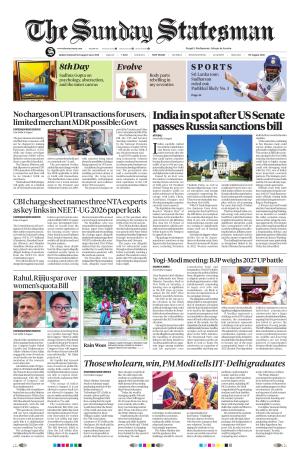
www.thestatesman.com | FOLLOW US: India’s National Newspaper since 1818 @TheStatesmanLtd | Pages 16 8th Day @thestatesmanltd | ` 5.00 | People’s Parliament, Always in Session thestatesman1875 KOLKATA | NEW DELHI | MUMBAI Evolve Sadhna Gupta on psychology, abstraction, and the inner canvas | BHUBANESWAR | LUCKNOW | SILIGURI | 09 August 2026 S P O RT S Body parts rebelling in my seventies Sri Lanka tour: Sudharsan ruled out; Padikkal likely No. 3 Page 16 No charges on UPI transactions for users, limited merchant MDR possible: Govt STATESMAN NEWS SERVICE New Delhi, 8 August The government on Saturday clarified that consumers will not be charged for making payments through the Unified Payments Interface (UPI), while any future merchant discount rate (MDR) will be limited to select transactions above a specified threshold. The Finance Ministry said that all person-to-person (P2P) UPI transactions will continue to remain free and there will be no blanket MDR on merchants. “If introduced, MDR charges will apply only to a limited set of merchant transactions above a certain threshold and at a nominal rate,” it said. The government further added that such charges would be significantly lower than the MDR applicable to debit or credit card transactions. The clarification comes amid debate over a recent amendment to the Payment and Settlement Systems Act, 2007, with concerns being raised about the possibility of charges being imposed on UPI users. In addition, the government said the amendment is an enabling provision aimed at ensuring the long-term sustainability, technological development and resilience of the UPI ecosystem. The proposed changes are part of the Taxation and Other Laws (Amendment) Bill, 2026. Once Parliament passes the Bill, the ‘UPI and Services Steering Committee’ ~ headed by the National Payments Corporation of India (NPCI) ~ will decide on the MDR, if any, the government said. It said UPI’s rapidly increasing transaction volumes require continued investment in cybersecurity, fraud prevention and technology infrastructure. The government also said a sustainable revenue model is needed to encourage more companies to expand their operations in the UPI ecosystem and reduce reliance on subsidies. CBI charge sheet names three NTA experts as key links in NEET-UG 2026 paper leak STATESMAN NEWS SERVICE Pune, 8 August The Central Bureau of Investigation (CBI) has alleged that three subject experts associated with the National Testing Agency (NTA), P V Kulkarni (Chemistry), Manisha Hawaldar (Physics), and Manisha Mandhare (Botany and Zoology), played a key role in the alleged leaking of questions from the NEET-UG 2026 examination paper. The CBI has filed a 94-page charge sheet against 13 accused before a special court in connection with the NEET-UG paper leak case. Investigators have relied on records from the access-control application of the housing society where Pune-based accused Kulkarni lived, besides biometric data, mobile call-detail records and location analysis. The charge sheet details how the three experts allegedly exploited security lapses in the NTA’s confidential section. There was no dedicated directrecording control unit for the confidential section, leaving the movements of the accused experts largely unmonitored. Ms Mandhare, who was responsible for translating the Botany paper from English into Marathi and retranslating the Zoology paper, allegedly marked relevant passages from NCERT textbooks after returning to her hotel. The CBI has claimed that her experience enabled her to easily link the examination questions with the textbook content. Ms Hawaldar, who was assigned the Physics translation work, allegedly made brief notes of the questions after returning to her residence in Delhi at the end of each da. The CBI has further alleged that the leaked question paper was passed on by Pune-based beautician Manisha Waghmare through intermediaries to Rajasthan and Haryana. The paper was allegedly sold for substantial sums through a chain of middlemen before eventually reaching a student. The student’s complaint to the NTA subsequently helped bring the alleged paper leak to light. India in spot after US Senate passes Russia sanctions bill ARTI BALI New Delhi, 8 August I ndia’s carefully crafted ties with the United States and Russia have come under pressure after the US Senate approved legislation that could expose countries buying Russian oil and gas to tariffs of up to 100 per cent, potentially placing New Delhi at the centre of a fresh economic and diplomatic confrontation. Passed by an 86-11 vote, the Lindsey O. Graham Sanctioning Russia and Iran Act of 2026 gives US President Donald Trump the power to impose punitive tariffs on major purchasers of Russian energy, with India, China, Azerbaijan, Hungary and Slovakia among the countries currently most exposed. The legislation also targets Russia’s “shadow fleet” of tankers and extends the Iran Sanctions Act for another five years. However, the Bill must first clear the US House of Representatives, which is currently on recess until September, before it goes to Mr Trump to be signed into law. The package would impose mandatory sanctions on top figures in the Russian government, including President STATESMAN NEWS SERVICE New Delhi, 8 August Ahead of the crucial last week of the ongoing Monsoon Session, Congress leader Rahul Gandhi and Parliamentary Affairs Minister Kiren Rijiju engaged in a war of words on social media over the implementation of the women’s reservation law. Lok Sabha Leader of Opposition (LoP) Rahul Gandhi said the Women’s Reservation Bill, 2023, had already been passed unanimously with the “full support of Congress” and questioned why it had not yet been implemented. “Mr Rijiju, who would know better than you, as the Minister of Parliamentary Affairs, that the Women’s Reservation Bill 2023 has already been passed unanimously, with the full support of the Congress. “The question is, why has it still not been implemented even after three years, and why do you now want to unnecessarily link it to delimitation? Implement the 2023 law, without any conditions,” he said. The exchange began after Mr Rijiju referred to Mr Gandhi’s earlier remarks on women’s reservation, describing them as a “positive message” from the Congress. “There’s a visible change of heart in Shri Rahul Gandhi Ji about the Women’s Reservation Bill. Now, I hope Congress Party will support the Women’s Reservation Bill unconditionally,” Mr Rijiju posted on X. Mr Gandhi had stressed the need for greater participation of women in public life, saying India cannot realise its full potential unless women are able to express themselves freely and pursue their aspirations. “The energy of India’s women is trapped. It is not allowed to express itself. It is not allowed to imagine. For me, no country can be successful if its women are not expressing themselves,” he said. The Constitution (131st Amendment) Bill, 2026, was introduced in April to fast-track the implementation of 33 per cent reservation for women in the Lok Sabha and state Assemblies by using the 2011 Census for early delimitation. The Bill, however, failed to clear the Lok Sabha after falling short of the required two-thirds majority. Rain Woes Villagers wade through a flooded road following heavy rainfall in Assam’s Nagaon district on Saturday. AGENCIES and the withdrawal of several traditional buyers have enabled Indian refiners to secure Russian oil at discounted prices. Russia subsequently emerged as India’s dominant crude supplier, with its oil accounting for more than half of India’s crude imports in June. That has helped India contain energy costs and protect itself from wider fluctuations in global oil markets. But any significant disruption could have consequences well beyond the refining sector, affecting fuel prices, inflation, transportation, industrial activity and the country’s import bill. The challenge has increased as disruptions linked to the Strait of Hormuz have pushed Yogi-Modi meeting: BJP weighs 2027 UP battle SHAHID K ABBAS New Delhi, 8 August Rahul, Rijiju spar over women’s quota Bill Vladimir Putin, as well as Russian oligarchs, state-owned enterprises and foreign companies supporting Russia’s defence industrial base. There was no immediate reaction from New Delhi. With US Trade Representative Jamieson Greer determining the final tariff level, the Bill allows an exemption for countries that import less than 15 per cent of Russia’s total natural gas exports and are working to significantly reduce their use of Russian natural gas. For India, the biggest vulnerability lies in its dependence on Russian crude. Since Moscow’s invasion of Ukraine in 2022, Western sanctions India further towards Russian supplies. At the same time, continuing to buy Russian crude could expose Indian exporters to potentially crippling US tariffs. This creates a difficult economic calculation for New Delhi: reducing Russian purchases could lead to higher energy costs, while maintaining them could risk damaging trade with the USA, one of India’s most important economic partners. The timing is particularly sensitive because India and the USA are already negotiating a trade agreement. Officials from both sides have maintained regular contact, with US Trade Representative officials visiting India and Indian delegations travelling to Washington. A 100 per cent tariff would also hurt American businesses and consumers, giving Washington an incentive to consider the wider economic consequences before using the measure aggressively. The dispute also carries major geopolitical implications. Russia remains a longstanding defence and diplomatic partner, while India has moved closer to Washington in recent years, particularly as strategic competition with China has intensified. Uttar Pradesh Chief Minister Yogi Adityanath met Prime Minister Narendra Modi in New Delhi on Saturday, a meeting seen as significant as the BJP steps up preparations for the 2027 Uttar Pradesh Assembly elections. The BJP, in the run-up to the elections in the Hindi heartland state, faces a set of political challenges that could determine whether its formidable electoral machinery can overcome the vulnerabilities exposed in the 2024 Lok Sabha elections. Among the issues that could acquire greater political weight in the run-up to the elections are the allegations surrounding the handling of donations linked to the Ram Mandir in Ayodhya and the all-too-apparent anger among students and job aspirants over examination leaks and irregularities. The BJP’s ability to contain the political fallout from allegations concerning a religious project central to its ideological narrative, while simultaneously responding to anger over jobs and examinations, are likely to become an important test of its campaign strategy. The allegations surrounding alleged theft or misappropriation of donations associated with the Ram Mandir are likely to be used by the Opposition to question transparency and accountability in the management of funds collected in the name of the temple. For the Opposition, the issue is politically useful precisely because Ayodhya occupies such an important place in the BJP’s narrative. The Samajwadi Party and other Opposition parties are likely to seek to frame the controversy as a question of accountability involving one of the country’s most politically significant religious institutions. If Ayodhya represents a challenge to the BJP’s cultural narrative, the examinationleak controversy represents a challenge to its governance and development narrative. The agitation by students and examination aspirants over alleged paper leaks, irregularities and delays has the potential to become one of the more consequential issues of the 2027 election. The Opposition is likely to attempt to convert individual examination controversies into a larger narrative of institutional failure, arguing that the government has failed to protect the aspirations of young people. The BJP will have to demonstrate that examination systems are secure, recruitment processes are credible and deserving candidates are not being deprived of opportunities because of leaks, cancellations or administrative delays. Those who learn, win, PM Modi tells IIT-Delhi graduates STATESMAN NEWS SERVICE New Delhi, 8 August Prime Minister Narendra Modi on Saturday urged graduating students of the Indian Institute of Technology (IIT), Delhi, to remain curious and keep learning throughout their lives, saying that the rapid pace of technological change would determine the future of the world and create new opportunities for those willing to adapt. Addressing the 57th convocation ceremony of IIT Delhi as the chief guest, Mr Modi said the world was changing at an unprecedented pace and that it was impossible to predict what the next two or three decades would look like. He called upon the students to continuously upgrade their knowledge and skills instead of becoming complacent after completing their formal education. “Today, the world is changing rapidly. Nobody can say what will happen 20-30 years from now. Keep your curiosity alive in life... Keep your learning instinct alive. Those who learn, win,” the Prime Minister said. Emphasising the close link between technological change and shifts in global power, Mr Modi said: “Global power balance is changing every moment; the biggest force behind it is the speed of technology.” He said technology would continue to transform economies, industries and societies, making the ability to learn, adapt and innovate increasingly important. The Prime Minister also told the graduates that challenges should be viewed as opportunities for innovation. “Challenges become chances for those who have the courage to find new solutions,” he said, urging the students to use their education not merely to secure successful careers but also to develop solutions to problems confronting the country and the world. More than 3,000 students received degrees at the convocation, including 587 Ph.D. scholars. Mr Modi congratulated the graduating students and their families, saying their years at one of the country’s premier institutions had equipped them with knowledge and skills that could contribute to India's transformation. He cautioned the students against measuring their success only through salary packages, job designations or comparisons with their peers. Life, he said, was not a leaderboard in which success could be judged by comparing one’s achieve- ments with those of others. The Prime Minister encouraged the graduates to focus instead on becoming better versions of themselves and making progress in their own journeys. He said the real measure of achievement should be continuous improvement, learning and the ability to contribute meaningfully to society. In a lighter moment during the address, Mr Modi referred to the mixture of ambitions, startup ideas and emotions among the graduating students. “I am not Baba Bageshwar, but something must be going on in your hearts,” he said, drawing laughter from the audience.
The Statesman is one of India's oldest English newspapers. It was founded in Kolkata in 1875 and is directly descended from The Friend of India (founded 1818). The Englishman (founded 1821) was merged with The Statesman in 1934. The Delhi edition of The Statesman began publication in 1931. The Statesman Weekly is a compendium of news and views from the Kolkata and Delhi editions. Printed on airmail paper, it is popular with readers outside India. The Statesman (average weekday circulation approximately 180,000) is a leading English newspaper in West Bengal. The Sunday Statesman has a circulation of 230,000.